
Research
My research considered various artists for this project, these were not just photographers but a variety of artists who had inspired me throughout my master’s journey. This included Ann Brigman who not only was a photographer and author but also a poet in her own right.
When considering sustainability and eco-communities stereotypes, most of us think of the ‘hippie’ and ‘peace-loving’ individuals, very free in their way of thinking, I feel she fits into this bracket.
Ann Brigman
Discovering Brigman in a previous project, I liked her style, interpretation, and concept. Very different to all the other photographers of her period, I felt she was beyond
A free-spirited and determined lady, like myself, she has aspects to this project which I believe to be. . .
Nature seems to be at the forefront of Brigman’s work together with encompassing movement into her images. When we talk about nature, we are talking about Mother Earth. She is basically in that space where there are no manmade structures, it is just her outside in those elements. It would seem her imagery represents her relationship with nature and spirituality. This connection with the spirituality of nature, and the atmosphere created within Brigman’s imagery, reflects that of Coed. Her feeling of closeness with the natural world can be seen within those who have made Coed Hills their home.
Brigman uses the medium of black and white together with a manual camera, available at the time. This gave the images she produced a more impactful and eerie feeling to them. By using a lot of silhouettes and shadowing, would incorporate Brigman into her photographs, in a way that leaves her unrecognisable. It is as though she is camouflaged within the image and in a very barren landscape. One such image is of that below:
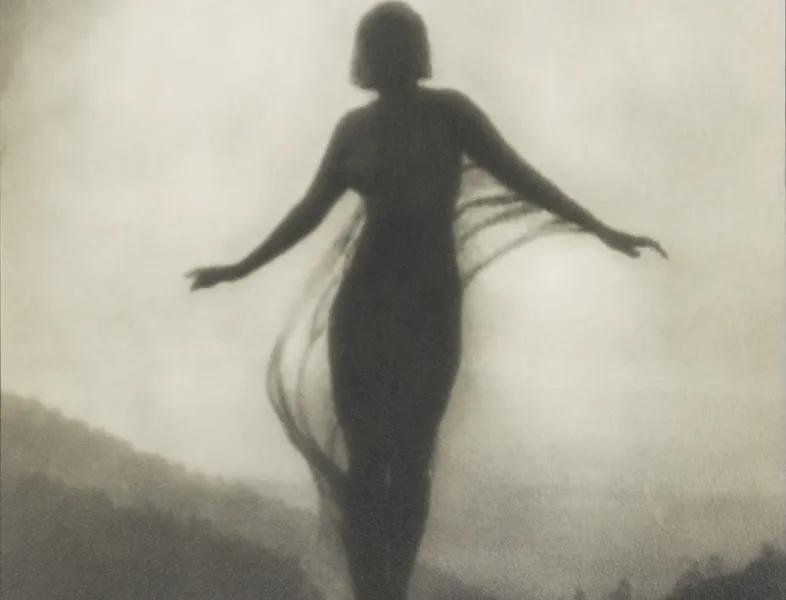
“The Breeze,” 1909 and printed 1915, gelatin silver print, was part of Brigman’s creative dialogue with nature and the human form. (Kleinman, 2018)
This shows nature and the human form. You can see the movement which I interpret as wind and the element of freedom. As you cannot see her features, this image would suggest an understanding of what it is like when as human beings our journey has ended on the earth plane, and we pass over to the spirit realm. The physical body changes to the form of spirit, leaving all pain behind. Even though we are not there, at that moment, there is passion within this image. It is as if there is a fire burning deep inside.
Brigman’s decision to write poetry describes in more detail the atmosphere, environment and feelings at the time. This compliments the imagery very well, drawing you into her world as an artist.
“Unseen”
What was it stirred the bough? . . .
There was no breath of wind! . . .
Why did the aspens tremble
In the quiet of sunset? . . .
Was it the shadow of trees
That slipped softly
Over the hill
Into the cañon? . . .
Why did the slim, young moon
Shine as of minted silver
And the little red foxes
Bark from their coverts? . . .
Then I knew, knew
In the breath of the wild rose . . .
Knew in the wild, sweet fragrance
Flooding the trail
That Beauty was passing . . .
Diana . . . the lovely and swift . . .
With her lean, gray, phantom hounds! . . .
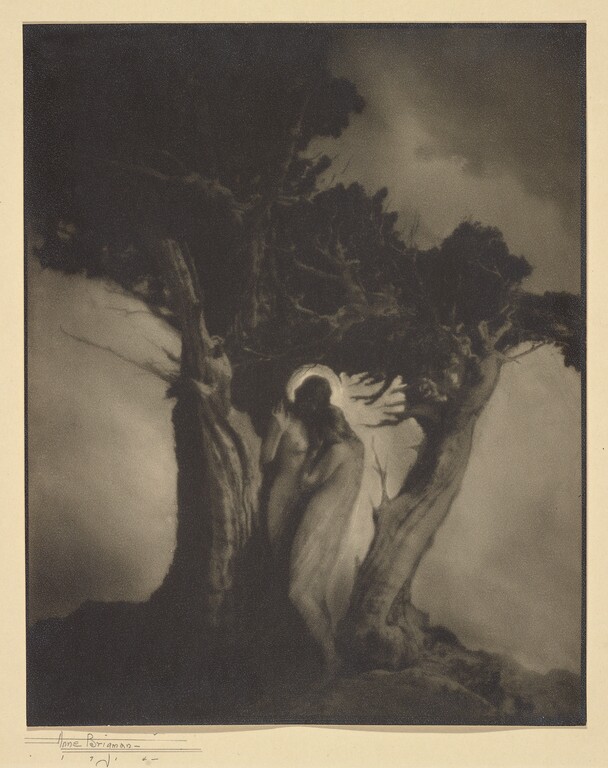
The Heart of the Storm is another of Ann Brigman’s pieces of work. Again, in the medium of black and white, with heavy contrast and having a tight crop which cuts off some of the branches of the tree. It would seem as if there were two people finding shelter by this tree. In the skyline, there are some very defined clouds
suggesting a storm is very close, the movement within the branches of the tree giving an impression of strong winds.
As per the description of the image through researching this image; it is actually that of a guardian angel figure, with an upraised hand as if in a blessing whilst consoling the cowering woman within a protective stand of California western juniper trees. Their faces are obscured, and the women seem to portray archetypes rather than individuals.
In Brigman’s work, the trees tortured by lighting and twisted by the winds symbolise independence and adaption to life’s adversity. When achieving a sense of atmosphere to each scene, Ann Brigman would alter her negative by hand, drawing and scratching lines onto the negative before printing. The halo above the left figure’s head was created by her, along with the sweep of lines appearing as a translucent, windblown garment on the figure at the right.
It could be suggested that all five elements are within the body of this image. Those being Earth, where the tree is planted in nature. Air is shown by the skyline and the movement of the trees. Fire is not visible but consider the beating heart of the woman being a flame. Water, again not visible but when thinking out of the box, consider the storm on the horizon and the weather being possible rain. Spirit, as per the description of the image; is that of an angel.
Brave in her approach, going against the grain, Brigman was not only an amazing landscape photographer, poet, and mountaineer. She was a pioneering feminist and suffragette during a period in history when in the San Francisco Call on 8 June 1913 it was published, she said: “Fear is the great chain which binds women and prevents their development, and fear is the one apparently big thing which has no real foundation in life. Cast fear out of the lives of women and they can and will take their place in the scheme of mankind and in the plan of the universe as the absolute equal of man.” Published in the San Francisco Call, June 8, 1913
(Wanzek, 2018)
Brigman was not afraid to express herself within her photography, nudity was an expression of the self in nature. In time she decided to manipulate her photographs to cast that side of her body in shadow or turn away from the camera putting the human figure “in rocks and trees”, she believed it was important “to make it part of the elements, not apart from them.”
This is described in her poem; “Tryst with the Wind”
Around my feet, small, dry leaves whirl
In a dusty dance with the whispering trees
And it’s glad I am of the wind in my hair,
And glad of its kiss on my breast and face
And its lift and swirl as I stand here bare
For my tryst with the wind
In the night
With a star.
The following video explains Ann Brigman’s work in more detail:
Whilst my imagery is not of Ann Brigman’s talent, I hope they will evolve in time. One thing I have learnt from Brigman is to get my work in the public eye, no matter how unique it is.